Auto Generated Primary Key In Jpa
The primary key fields are defined in an embeddable class.The entity contains a single primary key field that is annotated with @EmbeddedId javax.persistence.EmbeddedId JPA annotation Applied to a persistent field or property of an entity class or mapped superclass to denote a composite primary key that is an embeddable class. Fifa 18 licence key generator. See JavaDoc Reference Page. And contains an instance of that.
- Jpa Annotations Auto Generated Primary Key
- Auto Generated Primary Key In Jpa 2017
- Pengertian Primary Key
Every JPA entity is required to have a field which maps to primary key of the database table. Such field must be annotated with @Id.
Configuring JPA Entity Automatic Primary Key Generation. Typically, you associate a primary key field (see 'Configuring a JPA Entity Simple Primary Key Field') with a primary key value generator so that when an entity instance is created, a new, unique primary key value is assigned automatically. JPA and Hibernate support different strategies to generate primary key values. One of them is the identity strategy which uses an auto-incremented database column. If you want to use this strategy, you have to annotate the primary key attribute @Id and with the @GeneratedValue annotation and set the strategy attribute to GenerationType.IDENTITY. To generate primary key using auto-generation strategy, id attribute in the entity must be of String type. In order to use Auto-generation strategy, set strategy to GenerationType.AUTO. (This is default in case you don't specify any strategy). There are 4 strategies for auto generation in JPA: For Oracle auto generation primary key annotation, Sequence and Table are your choices. The basic logic is to define a generator first, use @SequenceGenerator or @TableGenerator respectively, then use the generator as attribute in @GeneratedValue. Sep 04, 2017 Although not a very common mapping, you can map a composite identifier where one of the Primary Key columns is auto-generated. While for a SEQUENCE identifier, we can use the JPA specification, for IDENTITY, we need to use the Hibernate-specific @SQLInsert annotation. Nevertheless, this mapping is possible when using Hibernate.
Simple vs Composite primary keys
A simple primary key consists of a single Java field which maps to a single table column.
A composite primary key consists of multiple Java fields which individually map to separate columns.
Supported types for a primary key
A simple primary key field or one of the composite primary key field should be one of the following types:
- Any Java primitive type
- any Any primitive wrapper type
- java.lang.String
- java.util.Date
- java.sql.Date
- java.math.BigDecimal
- java.math.BigInteger
In this tutorial we are going to focus on generation strategies of simple primary key.
@GeneratedValue Annotation
This annotation defines the types of primary key generation strategies. If this annotation is not used then application is responsible to populate and manage @Id field values itself.
This program can allow you to handle sales leads and opportunities greater and can let you build databases without any previous experience or technical personnel. Serials. You will find that Microsoft Office Professional 2007 helps you get your job done more efficiently and effectively.
The use of the GeneratedValue annotation is only required to be supported for simple primary keys.
GenerationType enum defines four strategies: Generation Type . TABLE, Generation Type. SEQUENCE, Generation Type. IDENTITY and Generation Type. AUTO. Let's understand them with examples.
GenerationType.SEQUENCE
With this strategy, underlying persistence provider must use a database sequence to get the next unique primary key for the entities.
We have created the following Util class to reuse the code for other examples.
Also, in the persistence.xml, we have created four persistence-unit, so that we can try four GenerationType independently. We are using Hibernate as persistence provider.
Let's create main class to try out Entity1 key generation.
Output
Above output shows one table MYENTITY1 and one sequence HIBERNATE_SEQUENCE are created.
GenerationType.TABLE
With this strategy, underlying persistence provider must use a database table to generate/keep the next unique primary key for the entities.
Output
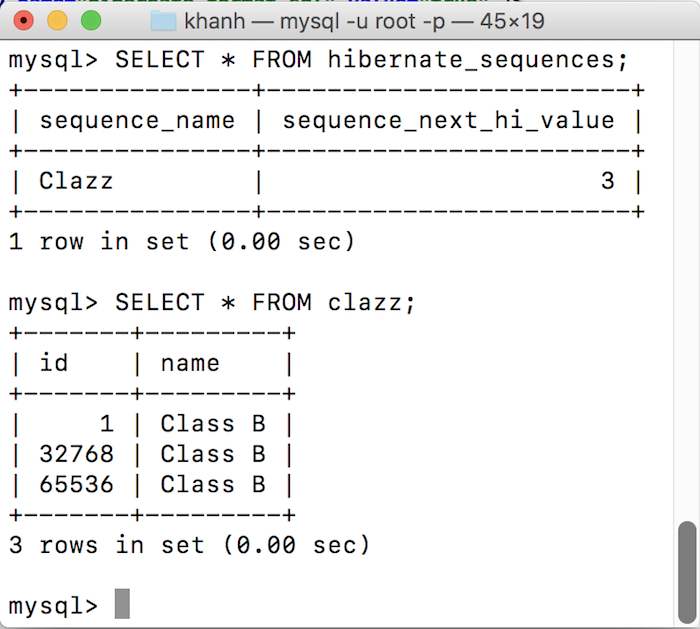
This time no sequence is generated, instead an additional table named 'HIBERNATE_SEQUENCES' is created to maintain primary key sequence.
GenerationType.IDENTITY
This GenerationType indicates that the persistence provider must assign primary keys for the entity using a database identity column. IDENTITY column is typically used in SQL Server. This special type column is populated internally by the table itself without using a separate sequence. If underlying database doesn't support IDENTITY column or some similar variant then the persistence provider can choose an alternative appropriate strategy. In this examples we are using H2 database which doesn't support IDENTITY column.
Output
Above output shows that a sequence is used for primary keys.
GenerationType.AUTO
Jpa Annotations Auto Generated Primary Key
This GenerationType indicates that the persistence provider should automatically pick an appropriate strategy for the particular database. This is the default GenerationType, i.e. if we just use @GeneratedValue annotation then this value of GenerationType will be used.
Auto Generated Primary Key In Jpa 2017
Output
Above output shows that a sequence is used for primary keys.
When @GeneratedValue not used
If we don't use @GeneratedValue annotation at all, then we have to populate the unique primary keys ourselves. In this example, we are simply assigning it to the value returned from System.nanoTime()
Output
Above output shows that a no sequence or extra table were generated.
Example Project
Dependencies and Technologies Used:
- h2 1.4.193: H2 Database Engine.
- hibernate-core 5.2.8.Final: The core O/RM functionality as provided by Hibernate.
Implements javax.persistence:javax.persistence-api version 2.1 - JDK 1.8
- Maven 3.3.9