Generate Ssh Rsa Key From Certificate
This will create and store both your public and private keys in your /.ssh directory. It will overwrite any existing keys as well. To generate these keys, simply type ssh-keygen -t rsa -b 2048 and follow the prompts. To install the keys to the default location, just. Sep 26, 2019 To generate an SSH key with PuTTYgen, follow these steps: Open the PuTTYgen program. For Type of key to generate, select SSH-2 RSA. Click the Generate button. Move your mouse in the area below the progress bar. Type a passphrase in the Key passphrase field. Click the Save private key button to. Mar 20, 2014 Generating Signing Keys. First, we need to generate some RSA keys that will function as the signing keys. Use any user you’d like, but the root user is probably a good idea. We will be creating keys called “serverca” and “serverca.pub” since these will be used to authenticate our servers. Let’s create these keys in our home directory. With SSH certificates, you generate a certificate authority (CA) and then use this to issue and cryptographically sign certificates which can authenticate users to hosts, or hosts to users. You can generate a keypair using the ssh-keygen command, like this: $ ssh-keygen -t rsa -b 4096 -f hostca -C hostca Generating public/private rsa key pair. Apr 02, 2019 Installation of SSH Keys on Linux - A Step-By-Step Guide. Outlined below is a step-by-step guide detailing the process of installing SSH Keys on a Linux server: Step One: Creation of the RSA Key Pair. The first step in the installation process is to create the key pair on the client machine, which would, more often than not, be your own system.
Contents
|
Parent page: Internet and Networking >> SSH
Public key authentication is more secure than password authentication. This is particularly important if the computer is visible on the internet. If you don't think it's important, try logging the login attempts you get for the next week. My computer - a perfectly ordinary desktop PC - had over 4,000 attempts to guess my password and almost 2,500 break-in attempts in the last week alone.
With public key authentication, the authenticating entity has a public key and a private key. Each key is a large number with special mathematical properties. The private key is kept on the computer you log in from, while the public key is stored on the .ssh/authorized_keys file on all the computers you want to log in to. When you log in to a computer, the SSH server uses the public key to 'lock' messages in a way that can only be 'unlocked' by your private key - this means that even the most resourceful attacker can't snoop on, or interfere with, your session. As an extra security measure, most SSH programs store the private key in a passphrase-protected format, so that if your computer is stolen or broken in to, you should have enough time to disable your old public key before they break the passphrase and start using your key. Wikipedia has a more detailed explanation of how keys work.
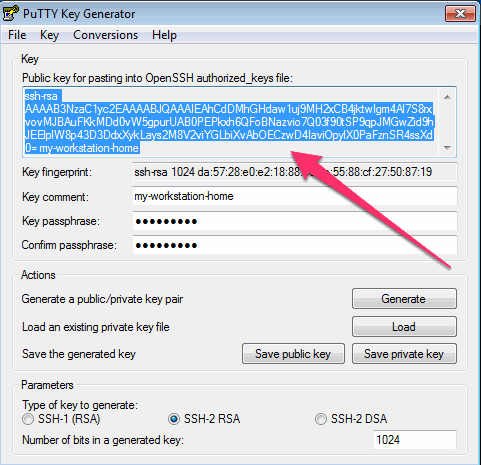
Public key authentication is a much better solution than passwords for most people. In fact, if you don't mind leaving a private key unprotected on your hard disk, you can even use keys to do secure automatic log-ins - as part of a network backup, for example. Different SSH programs generate public keys in different ways, but they all generate public keys in a similar format:
Key-based authentication is the most secure of several modes of authentication usable with OpenSSH, such as plain password and Kerberos tickets. Key-based authentication has several advantages over password authentication, for example the key values are significantly more difficult to brute-force, or guess than plain passwords, provided an ample key length. Other authentication methods are only used in very specific situations.
SSH can use either 'RSA' (Rivest-Shamir-Adleman) or 'DSA' ('Digital Signature Algorithm') keys. Both of these were considered state-of-the-art algorithms when SSH was invented, but DSA has come to be seen as less secure in recent years. RSA is the only recommended choice for new keys, so this guide uses 'RSA key' and 'SSH key' interchangeably.
Key-based authentication uses two keys, one 'public' key that anyone is allowed to see, and another 'private' key that only the owner is allowed to see. To securely communicate using key-based authentication, one needs to create a key pair, securely store the private key on the computer one wants to log in from, and store the public key on the computer one wants to log in to.
Using key based logins with ssh is generally considered more secure than using plain password logins. This section of the guide will explain the process of generating a set of public/private RSA keys, and using them for logging into your Ubuntu computer(s) via OpenSSH.
The first step involves creating a set of RSA keys for use in authentication.
This should be done on the client.
To create your public and private SSH keys on the command-line:
You will be prompted for a location to save the keys, and a passphrase for the keys. This passphrase will protect your private key while it's stored on the hard drive:
Your public key is now available as .ssh/id_rsa.pub in your home folder.
Congratulations! You now have a set of keys. Now it's time to make your systems allow you to login with them
Choosing a good passphrase
You need to change all your locks if your RSA key is stolen. Otherwise the thief could impersonate you wherever you authenticate with that key.
An SSH key passphrase is a secondary form of security that gives you a little time when your keys are stolen. If your RSA key has a strong passphrase, it might take your attacker a few hours to guess by brute force. That extra time should be enough to log in to any computers you have an account on, delete your old key from the .ssh/authorized_keys file, and add a new key.
Your SSH key passphrase is only used to protect your private key from thieves. It's never transmitted over the Internet, and the strength of your key has nothing to do with the strength of your passphrase.
The decision to protect your key with a passphrase involves convenience x security. Note that if you protect your key with a passphrase, then when you type the passphrase to unlock it, your local computer will generally leave the key unlocked for a time. So if you use the key multiple times without logging out of your local account in the meantime, you will probably only have to type the passphrase once.
If you do adopt a passphrase, pick a strong one and store it securely in a password manager. You may also write it down on a piece of paper and keep it in a secure place. If you choose not to protect the key with a passphrase, then just press the return when ssh-keygen asks.
Key Encryption Level
Note: The default is a 2048 bit key. You can increase this to 4096 bits with the -b flag (Increasing the bits makes it harder to crack the key by brute force methods).
Password Authentication
The main problem with public key authentication is that you need a secure way of getting the public key onto a computer before you can log in with it. If you will only ever use an SSH key to log in to your own computer from a few other computers (such as logging in to your PC from your laptop), you should copy your SSH keys over on a memory stick, and disable password authentication altogether. If you would like to log in from other computers from time to time (such as a friend's PC), make sure you have a strong password.
The key you need to transfer to the host is the public one. If you can log in to a computer over SSH using a password, you can transfer your RSA key by doing the following from your own computer:
Where <username> and <host> should be replaced by your username and the name of the computer you're transferring your key to.
Due to this bug, you cannot specify a port other than the standard port 22. You can work around this by issuing the command like this: ssh-copy-id '<username>@<host> -p <port_nr>'. If you are using the standard port 22, you can ignore this tip.
Another alternative is to copy the public key file to the server and concatenate it onto the authorized_keys file manually. It is wise to back that up first:
You can make sure this worked by doing:
You should be prompted for the passphrase for your key:
Enter passphrase for key '/home/<user>/.ssh/id_rsa': |
Enter your passphrase, and provided host is configured to allow key-based logins, you should then be logged in as usual.
Encrypted Home Directory
If you have an encrypted home directory, SSH cannot access your authorized_keys file because it is inside your encrypted home directory and won't be available until after you are authenticated. Therefore, SSH will default to password authentication.
To solve this, create a folder outside your home named /etc/ssh/<username> (replace '<username>' with your actual username). This directory should have 755 permissions and be owned by the user. Move the authorized_keys file into it. The authorized_keys file should have 644 permissions and be owned by the user.
Then edit your /etc/ssh/sshd_config and add:
Finally, restart ssh with:
The next time you connect with SSH you should not have to enter your password.
username@host's password:
If you are not prompted for the passphrase, and instead get just the
prompt as usual with password logins, then read on. There are a few things which could prevent this from working as easily as demonstrated above. On default Ubuntu installs however, the above examples should work. If not, then check the following condition, as it is the most frequent cause:
On the host computer, ensure that the /etc/ssh/sshd_config contains the following lines, and that they are uncommented;
If not, add them, or uncomment them, restart OpenSSH, and try logging in again. If you get the passphrase prompt now, then congratulations, you're logging in with a key!
Permission denied (publickey)
If you're sure you've correctly configured sshd_config, copied your ID, and have your private key in the .ssh directory, and still getting this error:
Permission denied (publickey). |
Chances are, your /home/<user> or ~/.ssh/authorized_keys permissions are too open by OpenSSH standards. You can get rid of this problem by issuing the following commands:
Error: Agent admitted failure to sign using the key.
This error occurs when the ssh-agent on the client is not yet managing the key. Issue the following commands to fix:
This command should be entered after you have copied your public key to the host computer.
Debugging and sorting out further problems
The permissions of files and folders is crucial to this working. You can get debugging information from both the client and server.
if you think you have set it up correctly , yet still get asked for the password, try starting the server with debugging output to the terminal.
To connect and send information to the client terminal
No matter how your public key was generated, you can add it to your Ubuntu system by opening the file .ssh/authorized_keys in your favourite text editor and adding the key to the bottom of the file. You can also limit the SSH features that the key can use, such as disallowing port-forwarding or only allowing a specific command to be run. This is done by adding 'options' before the SSH key, on the same line in the authorized_keys file. For example, if you maintain a CVS repository, you could add a line like this:
When the user with the specified key logged in, the server would automatically run /usr/bin/cvs server, ignoring any requests from the client to run another command such as a shell. For more information, see the sshd man page. /755
Finding your Private Key on Different Servers or Control Panels
Linux-Based (Apache, Nginx, LightHttpd)
Windows Operating Systems
Mac OS X
Tomcat
cPanel
WHM
Plesk
Synology NAS DSM
Webmin
VestaCP
DirectAdmin
Webuzo
What Is a Private Key?
What Is a Private Key?
You’ve received your SSL Certificate, and now you need to install it.
Firstly, let’s go through some basics. Public Key Infrastructure (PKI) security is about using two unique keys: the Public Key is encrypted within your SSL Certificate, while the Private Key is generated on your server and kept secret.
Learn how to use your SSH key in your GitHub workflowWhy Use an SSH Key?When working with a GitHub repository, you'll often need to identify yourself to GitHub using your username and password. Generate your own SSH key pair.  Add your SSH key to your GitHub account. Objectives. Explain what an SSH key is.
All the information sent from a browser to a website server is encrypted with the Public Key, and gets decrypted on the server side with the Private Key. Together the key pair keeps communication secured, and one key will not work without the other.
How do I get it?
The Private Key is generated with your Certificate Signing Request (CSR). The CSR is submitted to the Certificate Authority right after you activate your Certificate. The Private Key must be kept safe and secret on your server or device, because later you’ll need it for Certificate installation.
Note: all Certificates except Multi-Domains support Private Key generation in your browser. The key is always saved during SSL activation, we never receive this information. That’s why it’s important you save and back it up during the process if you use the in-browser automatic generation method. If the Private Key key file is lost, you’ll need to reissue your Certificate.
Can I generate a new Private Key for my Certificate if I lose the old one?
Yes. You can generate a new private key and CSR, or use the automatic CSR and key generation during Certificate reissue (this option is available for all Certificates except for the Multi-Domains).
What does the Private Key look like?
It looks like a block of encoded data, starting and ending with headers, such as —–BEGIN RSA PRIVATE KEY—– and —–END RSA PRIVATE KEY—–.
You may not get to see this code when generating your CSR. Usually, it gets generated in the background with the CSR, and is automatically saved on your server. The system also fills the corresponding field automatically during installation of your Certificate in some control panels, such as cPanel.
The way this works varies depending on your web server, control panel, or any other tools used for CSR generation. Select the one that applies to you in the following section for specific guidance.
Finding your Private Key on Different Servers or Control Panels
Linux-based (Apache, NGINX, LightHttpd)
Normally, the CSR/RSA Private Key pairs on Linux-based operating systems are generated using the OpenSSL cryptographic engine, and saved as files with “.key” or “.pem” extensions on the server.
But no specific extensions are mandatory for text files in Linux, so the key file may have any name and extension, or no extension at all.
If you remember the whole name of the key file or at least part of it, you can use the following command in your console to find the file and its directory:
The slash symbol in this command implies that the search begins from the root directory of the server. This way you have more file options to view. The name of the file in between the single quotation marks should be the part of the name that you remember. To search for the file by extension, enter “*.key” to view all the files with the “.key” extension on your server.
Tip: often the name of the file corresponds to the domain name it was generated for e.g. “domain_tld.key” or “domain.tld.pem”.
Here’s another useful command that lets you search files by their content:
This command will return the absolute path to the Private Key file if it’s located on your server.
Windows Operating Systems (IIS, Exchange, Small Business server)
Windows servers don’t let you view the Private Key in plain text format. When you import your Certificate via MMC or IIS, the Private Key is bound to it automatically if the CSR/Key pair has been generated on the same server.
If you need to obtain the Private Key to install your Certificate on a different server, you can export the key in a password protected PFX (PKCS#12) file. To do that, open the MMC Certificates snap-in tools following these steps:
Win+R >> mmc.exe >> OK >> File >> Add/Remove Snap-in >> Certificates >> Add >> Computer account >> Next >> Local computer >> Finish >> OK
Next, go to Certificate Enrollment Requests >> Certificates (if you haven’t completed the Certificate request yet). If you’ve done that, you’d select Personal >> Certificates, then right-click the Certificate >> select All Tasks >> Export. The Export wizard will open, and give you instructions. You can find more detailed instructions here.
Once that’s done, you will see the .pfx file containing your Certificate, CA-Bundle, and Private Key. To extract the key, use this tool. Choose the PKCS12 to PEM option, then upload the file and enter your chosen password.
Mac OS X
The Keychain tool in the Server application of Mac OS X won’t allow you to access the Private Key via the graphic user interface. Instead use the Terminal, by opening /etc/certificates/ directory and clicking the file.
Its name should be something like “*.key.pem”. And the terminal commands to open the file are: cd /etc/certificates/ , then ls , and sudo nano test.key.pem.
Note: to check if the Private Key matches your Certificate, go here. Then paste the Certificate and the Private Key text codes into the required fields and click Match.
Tomcat
If your Tomcat SSL connector is configured in JSSE style, the Private Key must be in a password-protected keystore file with a .jks or .keystore extension. This file, unlike most other cases, is created before the CSR. To extract the Private Key, you’ll need to convert the keystore into a PFX file with the following command:
Tips:
- “Keystore.jks” should be replaced with your actual keystore name,
- “keystore.p12” will be the name of the PKCS12 file you will receive,
- <jkskeyalias>, <jkspassword> and <keypassword> are the alias (key and keystore passwords that were entered during keystore generation),
- <jkskeyalias>, <jkspassword> and <keypassword> should be replaced with your JKS file alias, its password, and Private Key password.
- <newp12password> and <newkeypassword> should be replaced with the passwords you set for your new PKCS12 file and the Private Key.
After the PKCS12 file is generated, you can convert it to a PEM file with separated CRT, CA-Bundle and KEY files using this tool. Alternatively, use the following command in the terminal:
“Private.key” can be replaced with any key file title you like.
cPanel
- SSL/TLS Manager
a) The simplest way to get the appropriate key used during SSL installation is reflected in the below picture:
b) Alternatively, you can find the Private key in the Private keys section of the SSL/TLS Manager, which can be located in the cPanel main menu. You will see all the Private Keys ever generated in your cPanel. To view the code of the key, click View & Edit. If there are several keys in that menu, you can copy each of them to find a match with your Certificate code by using this tool. - File manager
On the homepage of your cPanel, click File manager. Find the folder named “ssl” in the folder tree to the left (see screenshot). That folder will contain another folder named “keys”. This key folder also contains all the keys ever generated in your cPanel.
WHM
WHM stores your private keys and CSR codes in the SSL Storage Manager menu. On the homepage, click SSL/TLS >> SSL Storage Manager. To view the Private Key, click the magnifier icon next to the relevant key in the Key column.
Plesk
Click Domains >> your domain >> SSL/TLS Certificates. You’ll see a page like the one shown below. The key icon with the message “Private key part supplied” means there is a matching key on your server.
To get it in plain text format, click the name and scroll down the page until you see the key code. Alternatively, click the green arrow icon on the right. This will download a PEM file, containing your Private Key, Certificate and CA-Bundle files (if they were previously imported to the server). The files can be opened in any text editor, such as Notepad.
Synology NAS DSM
When generating a CSR in Synology DSM, the Private Key is provided to you in a zip file on the last step. The key code is contained within a server.key file, that can be opened with a text editor, such as Notepad.
Webmin
Webmin works as a graphic user interface (GUI) on top of the command-line interface. There is also a file manager called Filemin, that you can use to browse the server file system and find your Private Key file. Alternatively, go to Others >> Command Shell and run the find or grep command, which you can find in the Linux Operating Systems section above.
VestaCP
Your Private Key needs to be saved during CSR generation, as it will not be available via the graphic user interface.
That said, you may be able to retrieve your Private Key via SSH. It is saved as a temporary file in the “/tmp” folder. The path to the file will look something like this: “/tmp/tmp.npAnkmWFcu/domain.com.key”.
Note: the files in the /tmp directory are deleted every time your server is rebooted, so this is not a safe place to store your Private Key.
To get the path to your key file, use this Linux command:
Where you see “domain.com”, replace this with the actual domain name you generated the CSR for.
Download Serial Key Generator from official sites for free using QPDownload.com. Free download. How much does it cost to download Serial Key Generator?Nothing! How do I access the free Serial Key Generator download for PC?It's easy! Additional information about license you can found on owners sites. Just click the free Serial Key Generator download button at the top left of the page.
The path to your key file can also be found using the grep command:
DirectAdmin
In the up-to-date version of DirectAdmin, your Private Key is saved on the server. Access it in the “Paste a pre-generated Certificate and key” field during installation.
If that section is empty, it may mean the CSR and key were generated elsewhere, or the key was not saved in DirectAdmin due to a glitch. If a glitch happened, try retrieving the key via SSH. Usually it is saved in this directory:
/usr/local/directadmin/data/users/<user>/domains/<domain>.key
Note: <user> and <domain> are your DirectAdmin details.
Generate Ssh Rsa Key From Certificate Download
Webuzo
Generate Ssh Rsa Key From Certificate Pdf
On the homepage, find the SSL management section by clicking the Private Keys button. This will display a list of all the Private Keys generated in Webuzo. To see the key code, click the pencil icon to the right under the Option column, as shown in the screenshot below:
Ssh Rsa Key
To sum up, ways to find your private key fully depend on the interface of the web server where you generate the CSR. If the methods described above did not help you find the private key for your certificate, the only solution would be to generate a new CSR/private key pair and reissue your certificate and to make sure that the key is saved on your server/local computer this time.